Power and Mercy
Luke 23:33-43
Emmanuel Baptist Church; Rev. Kathy Donley
November 16, 2025
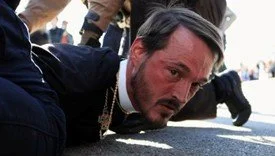
Image: Rev. Michael Woolf, under arrest at Broadview Detention Facility in Chicago
Note: A recording of the worship service in which this sermon was preached may be found here: https://www.youtube.com/watch?v=GDvrBw7F4JQ
We are approaching the end of the church year. In traditions that follow the liturgical calendar, the last Sunday of the year is designated as Reign of Christ Sunday. That has only been true for the last century, by the way. This designation came about in 1925 as a response to the rise of totalitarian ideologies in Europe. The intent was to affirm the authority of Christ as the truest, highest ruler of the world. So, we are invited to consider this vignette of Jesus on the cross within the context of his life and ministry.
Delores Williams was an African American womanist theologian. Womanism is a perspective that centers the experience of women of color. Williams remembers Sunday mornings in the churches of her childhood, where preaching was a very interactive experience, because the people in the pews talked back to the pastor. She describes the minister in the pulpit shouting out, “Who is Jesus?” The choir would respond from behind, “King of kings and Lord Almighty!” And then, she says, an elderly woman from the back of the church is a voice so fragile and frail you could hardly hear her, would sing her own answer, “Poor little Mary’s boy.” Back and forth they sang “King of Kings and Lord Almighty . . . poor little Mary’s boy.” Williams says this was the black church doing theology.[1] Who is Jesus? King of Kings cannot be the only answer. Poor little Mary’s boy is there too. These images clash.
Poor little Mary’s boy is easiest to see here. He is being executed by crucifixion, a form of death by torture meant to humiliate the condemned and intimidate the masses and project imperial power. Jesus has been forsaken by most of his friends and mocked by his enemies. He has been beaten. He is in pain and afraid. A sign over his cross sarcastically proclaims him King of the Jews. It’s a warning about what happens to people who pose a threat to petty tyrants who abuse their power. Poor little Mary’s boy is subject to the rule of domination, terror and contempt.
The cruelty is the point. We understand this in a tangible way as we bear witness to what immigration enforcement is doing on our streets and outside our schools and in our courthouses. Abandoning due process and the rule of law, they attack and arrest people without evidence of a crime, they intimidate onlookers and protestors, they refuse to identify themselves. Once people are taken by the authorities, they are held in places which were intended to be temporary. Holding cells without showers or adequate food service. Transported with shackles. Remember the images of those who were deported to CECOT in El Salvador? There and also here in this country, those abducted are physically cramped, crammed together forced into contact and intimacy with strangers. It is dehumanizing. The cruelty is the point.
This is a new facet of crucifixion for me. Jesus, on the cross, is physically close to other supposed insurrectionists. He is associated with them because the authorities have lumped them together, without any care for guilt or innocence. He is forced into a kind of intimacy with these strangers because of their shared suffering and dehumanization. Who is Jesus? – poor little Mary’s boy.
In the midst of his pain, Jesus says “Father forgive them for they don’t know what they’re doing.” He offers mercy even while none is being offered to him. He continues to see his oppressors as humans as they seek to strip him of every shred of dignity and humanity. He gives them the biggest benefit of the doubt – surely if they understood what they were doing, they would stop, and for that failure to understand, they need to be forgiven.
These words from Jesus are often held up as an example for us to follow. But for victims of violence and trauma, that may increase a sense of guilt and pain. It might be helpful to see this nuance – Jesus does not instantaneously pronounce forgiveness on his executioners, but he pleads with God to forgive them.[2] Sometimes that is all that we can do. But to continue to recognize our enemies as humans, as people who could make better choices and might yet do so —that seems to me to be an exercise of love.
One of the strangers dying near Jesus uses up some of his precious air to say, “Remember me when you come into your basileia.” Basileia is a Greek word which can refer to the area ruled by a king, (a kingdom) or to the power or authority to rule as king. So, the criminal next to Jesus says, “Remember me when you come into your kingdom. Remember me when you come into your power.”
This is surely an absurd conversation. Jesus has a sign above his cross that proclaims, “King of the Jews.” It is a sign of derision, of mockery. He is nailed to a cross. The whole point of crucifixion is to demonstrate ruthlessly, without question, that Rome has all the power and those crucified are powerless.
But the man says, “When you come into your power . . . Remember me.” Somehow, in his last moments, this man comprehends that Jesus is something more than he appears. He understands that Rome, for all its power and violence, is not completely in control of this situation. “Remember me when you come into your power.”
We know this and simultaneously we resist knowing it. God chose to reveal God’s self most completely in the vulnerable helplessness of an infant and in the brokenness of an executed man. [3] So here, somehow, we see not just poor little Mary’s baby, but also the King of Kings and Lord Almighty.
Here’s why that matters: we affirm that we are made in the image of God. Whenever we make that affirmation, we need to be mindful of who that God is, of what that God is, and of how it is that we bear the image of that God. And so, if we say that God is a king and by that we mean an earthly dictator, then we may be tempted to see ourselves as co-rulers, equal with God and to lord it over others. But if we mean the God is the king who shares power, the one who enters into human suffering, the one who confronts evil with strength but not violence, with mercy and power, if that is what we mean by God as king, then it implies a whole different thing for us. A whole different understanding of how we act in bearing God’s image.
We have a lot of bad models today. A lot of Christians casually or intentionally adopting violence as a way of life. A public theology that holds up a punitive, violent God which leads to a lot of Christians who casually adopt violence as a way of life or who defend horrific treatment of others in God’s name. But there are others who do not, and I think we need to allow ourselves to be inspired by them.
A few examples – David Black, pastor of First Presbyterian in Chicago was praying outside the Broadview Detention Center in Chicago. He said, “I extended my arms, palms outstretched towards the ICE officers, in a traditional Christian posture of prayer and blessing. Without any warning or order to disperse, I was suddenly fired upon by ICE officers. In rapid fire, I was hit seven times on my arms, face and torso with exploding pellets that contained some kind of chemical agent. It was clear to me that the officers were aiming for my head, which they struck twice. and then hit full in the face with tear gas. One person writing about it said, “Rev. Black stood where Jesus would stand, alongside the detained, the displaced, the despised. Rev. Black stood where Christ would stand with the vulnerable, at the margins, and was met with the empire’s answer. He was met with violence from those who fear the gospel’s demand for justice.
Or Michael Woolf. He is an American Baptist and an Alliance of Baptist pastor and serves on the as one of the associate regional ministers for the American Baptist Churches of Metro Chicago. This is a picture of his most recent arrest, just two days ago. That may have been his third one. On Halloween, ICE agents carried out several raids in and around Chicagoland — including in Evanston, home of Lake Street Church, where Michael is pastor. He joined protests at the Broadview detention facility the next day. He said “For me, it’s really important to take some risks. While I’m in my clerical collar, it’s important because it’s not just about the public witness part. It’s actually healing for people to see the people who represent the church and represent God in public really care about this and that they’re not going to shrink from the violence. That they’re not afraid of what’s going to happen. And it’s so important for us to gather there. We have to challenge dehumanization at every single point we find it as people of faith. It’s so vital that we do that.”
This is Luke Harris-Ferree, another Chicago area pastor arrested for non-violent prayerful protest. The message on his shirt is so appropriate “Bad theology kills.”
Friends, this is the way our God chooses to use power – with forgiveness and mercy and the strength of vulnerability and love, a love that holds nothing back and even blesses enemies. May we be imitators of Christ and not the ways of power in this world.
Who is Jesus? Poor little Mary’s boy and King of Kings and Lord Almighty. Thanks be to God.
[1] https://www.patheos.com/blogs/onscripture/2012/11/a-different-kind-of-king-john-18-33-37/
[2] Barbara E. Reid, OP and Shelly Matthews, Wisdom Commentary: Luke 10-24, (Collegeville, MN: Liturgical Press, 2021), p. 612
[3] Michael Jinkins, Called to be Human: Letters to My Children on Living a Christian Life, (Grand Rapids: Eerdmans, 2009), p 32