By Stages
Genesis 11:31-12:10
Emmanuel Baptist Church; September 20, 2026
Rev. Kathy Donley
Do you remember the start of the pandemic? Going into lockdown, stores running out of toilet paper, a shortage on personal protection equipment for medical folks and no such things as masks for regular people, At first we acted like we were the first humans to ever have experienced anything like this. But gradually, we remembered. We remembered that just about a hundred years earlier, there was something known as the influenza epidemic. Turns out there were a lot of similarities between the two pandemics – things like social distancing and wearing face masks, but also refusal to cooperate with public health measures, conspiracy theories and quack treatments. As we lived through the pandemic and what followed, it was sometimes helpful to look back 100 years, to recognize the human foibles that repeat themselves across generations and to learn what we could from our ancestors’ experiences.
Biblical people did that too. Some 500 years before the time of Jesus, the people of ancient Judah found themselves in captivity. They lived in Babylon as exiles for about 50 years, struggling with issues of identity and purpose under the control of a foreign power. When they looked back, they told and retold the stories of their beginnings, learning what they could from their ancestors’ experiences, especially the experiences of those times when their ancestors were also wanderers or under the control of a foreign power. They took the stories that had been passed down from generation to generation by oral tradition for centuries. They took the pieces of those stories that addressed their experiences in exile and wrote them down. Scholars believe that the very first books of the Bible were shaped into written form, the form we now have, as the people of Judah continued to struggle with the long-term consequences of exile. [1]
The ways that we understand ourselves, as individuals and as communities, are layered. We see ourselves from where we stand now and also as interpreted by earlier generations.
Things have been rough lately. It is hard time for our country and because of our global reach, that struggle has impacted the people of many other nations. It is a hard time for Emmanuel as a community as we face a future that seems less settled, one that will require more of us than the recent past. And so, we look again to the experiences of God’s people in the past to address our questions of identity and purpose.
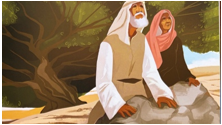
We start way way way back with Abraham. Verse 9 of today’s reading says “And Abram journeyed on by stages toward the Negeb.” The Negeb is the southern part of Palestine, by the way. But what catches my attention in that verse is by stages. Abram journeyed on by stages.
The journey is long. Stages are necessary. The journey will be multi-generational, extending forward in time to us and then beyond us. Stages are necessary and stages will repeat.
We begin with Abraham, but even before him, with his family. Tehrah, whose wife’s name is not recorded, had three sons – Abram, Nahor and Haran. Haran died young, leaving a son named Lot. We know nothing about Haran’s wife, Lot’s mother.
This family lived in a place called Ur at the bottom right of this map. For reasons unknown, Tehrah decided he wanted to move to Canaan. This is after his sons are grown and married that he decides to move, by the way. So he takes Abram and Sarai and his grandson Lot and heads out. We don’t know why Nahor and Milcah stay behind. There’s a desert directly between Ur and Canaan which means they have to go north. They travel about for a long time, making a journey of 1000 miles on foot or maybe on camel-back and when they get to Haran, they stop and settle there. They live there for decades until Terah dies. He never finishes the journey he started.
Sometime after Terah dies, it falls to Abram and Sarai and Lot to complete the journey to Canaan. Abram is 75 when they leave Haran, and they go, not only because it is a journey started a long time ago, but now God is also directing them to go.
Abram and Sarai’s story continues well beyond this point. But here, we are already aware of some of the stages – there was the time they lived in Ur where Abram grew up, and then moving to Haran as an adult, moving again to complete that interrupted journey, and they will continue to move in and around this area pushed and pulled both by economic circumstance and by the call of God.
The Biblical people found themselves in a hard place in Babylon and they looked back over their history to remember who they were and what they needed to do to thrive.
And so, today, I’m thinking about the stages of Emmanuel’s life and what we might remember about who we are and how we have been called according to God’s good purposes.
We might remember the stage when we were just a twinkle in the eye of First Baptist Church of Albany. They were just 23 years old when they had the vision to plant a new church in part of the city where there were no Baptists. And then 120 people left that spiritual home to establish a new one, in some sense continuing the same journey of faith.
We might remember the stage when the movers and shakers of Albany were numbered among our membership. William Marcy was on the first board of trustees of Pearl Street Baptist Church (Pearl Street was our name at one stage). William Marcy was also Governor of New York from 1833-1838. In that same era, Martin Van Buren, governor and US President, worshipped with our ancestors. As one of our recently departed members said, “Some very important people used to go to this church.”
There was a stage when we hosted revivals and planted churches. We hosted a series of revival meetings lasting 8 weeks in 1840. We were involved in planting churches on Washington Avenue and another part of State Street. In 1855, we helped Tabernacle build a chapel on Broadway and we paid their pastor’s wages. Later, some of those churches merged with each other and eventually people from some of the merged congregations came back to join Emmanuel. A few of you were here in 1970 for the union of Temple and Emmanuel.
At one time in our history, being absent from church services, questioning the church management or embracing the doctrine of Universal Salvation could get you excluded from the church fellowship. At a very different stage, embracing God’s beloved children in all their beautiful diversity, almost got us excluded from fellowship with other churches in our denomination. We have covered a lot of ground across our life span so far.
In 1868, a motion was brought to the congregation of Pearl Street Baptist Church. The motion called for an investigation into the possibility of merging with another Baptist congregation. It also authorized a committee to find out how much they could sell their building for and to look for a suitable new location on Capitol Hill. There is a historical echo between those actions in 1868 and very similar actions taken by this congregation in 2025, to put the building on the market and explore new possibilities.
Friends, we have been here before. The people of God have struggled – through political uncertainty and outright persecution, through seasons of theological certainty and also through times of stretching and re-imagining what we know of God, through times of great fruitfulness and also times of believing that our best days are behind us.
What stage are we in now? According to change theorist William Bridges, we find ourselves in the Neutral Zone. We are on our way to a new future, hoping to form a thriving community in a different location, but we’re not there yet. We are in the in-between phase where an old reality is ending, but the new one is not yet fully formed. This can be a place of great creativity and freedom to create new patterns. It is also a place of uncertainty, disorientation and anxiety.
We’ve been in this stage since our decisions in 2025 and maybe even back to the end of the pandemic. It is not a comfortable place for us, just as it was not a comfortable place for the Hebrew people as they wandered in the wilderness on their way to the promised land for 40 years. I have observed more conflict among you and experienced more conflict with you in the last 2 years than in all of the previous 14 years combined. Our feelings about the identity and purpose of our church are tangled up with our feelings about the identity and purpose of our country and vis versa. We are uncertain and angry and grieving and ready to move on . . . but not quite sure where to go or what to do or why. This is the neutral zone. Like it or not, we are here.
But God’s people have been here before. And we might learn some things from them. So for the next many weeks, we will be exploring the stories of the Exodus, Abram and Sarai’s descendants continuing the journey they started. We are going to do this in sermons and in conversations at dinner church. I invite you to participate in both. I know that is uncomfortable for some of us. The Neutral Zone is not a comfortable place and we’re going to be here for a while. I believe that the best way to get through it is together.
God called Abram out into the unknown, for the benefit of countless future generations, after his father had settled short of the goal. That call echoes forward in time by stages. No one accomplishes everything in a lifetime. We appreciate what our forebearers did and we pick up where they left off. This is today’s invitation – to see ourselves as Abraham and Sarai, listening and responding in a new way to God’s call reverberating from the past into the future.
[1]Kathleen M. O’Connor, Smyth & Helwys Bible Commentary: Genesis 1-25A, (Macon, GA: Smyth & Helwys Publishing, 2018) p. 3