Entertaining Angels
Genesis 18:1-10
June 7, 2026
Emmanuel Baptist Church; Rev. Kathy Donley
If I asked “how does God show up in your life?” some of you would say God shows up in the wonder and beauty of creation. Some of you would say God shows up in the scripture passages you know by heart or as a palpable sense of calm or confidence. Some of you would say in the moments when another person shares their own spiritual growth or insight with you.
If we asked Abraham “how does God show up in your life?” he might have said, “just like anyone else.” At the time of today’s reading, Abraham is 99 years old. He has been in relationship with God for decades, but most of that time, the Bible just says “now God appeared to Abraham” or “God told Abraham”. One time God appeared in a vision, while Abraham was sleeping, what we might call a dream. But most of the time, it seems that God and Abraham conversed just like Abraham might have conversed with his wife Sarah or his nephew Lot or anyone else.
There is no precedent in Abraham’s life for today’s encounter. He is at the oaks of Mamre, which is basically his home address. He is not expecting company, but when three strangers suddenly appear, he knows his duty. The code of normal everyday life in the ancient Middle East requires the offer of hospitality to anyone in need. In a nomadic desert culture, a person never knew when he himself might be in need, when her food or water would run out, when beasts of burden would need a rest, or storms or illness would require someone else’s generosity and mercy. So, you were expected to welcome strangers and even enemies as well as family and friends into your home without question, sustaining a safety net that you might also need one day.
Seeing these strangers, Abraham springs into action, inviting them to rest in the shade while he brings a bit of bread for refreshment. That offer turns into something much more -- with freshly-made bread and a full meal. The entire household is involved in the act of welcome. The strangers turn out to be divine messengers, but Abraham and Sarah provide a lavish welcome before they know that. The surprise comes later. The surprise comes when the strangers announce that in her old age, Sarah will have a son.
Now, God had previously told that to Abraham, in whatever way they usually conversed. But this is the first Sarah is hearing of it. I wonder why Abraham hasn’t mentioned it to her. I wonder if the unprecedented visit from strangers is to confirm for her the truth of this promise.
God shows up in the form of strangers who are received with welcome and the result is surprise and blessing. This experience is repeated often enough in Scripture, so that by the time the book of Hebrews is written thousands of years later, there is a shorthand description of it – showing hospitality to strangers is equated with the possibility of entertaining angels.
Two things we might notice about this encounter, one practical, one theological. First, the practical. Abraham gets a lot of credit for being an exemplary host, but if we read closely, he does very little of the actual work. He does hasten to the tent to tell Sarah to make the cakes quickly. Then he runs to the field to instruct the servant to slaughter the calf and prepare the meal. Other members of the household do the rest.
A lot of behind-the-scenes work goes into hospitality. Before last Sunday’s picnic, some unseen heroes recruited people to work the grill and went shopping and schlepped coolers of food and tubs of supplies to and from the park and saw to many, many other details. On Fridays for the last few weeks, a few dedicated folks have been showing up to accompany the Pride center youth as they create a float for the parade. In both instances, strangers have been welcomed and blessings have been received which is truly wonderful, but my point is that hospitality involves real intention and work.
Theologically, we see that God shows up in the form of three ordinary travelers on an otherwise ordinary day. God stands nearby and waits. Abraham sets aside his plans for the day, his comfort and convenience. Perhaps he is risking his own safety, because these are strangers after all, but he receives and welcomes them.
Kyong-Jin Lee is an Old Testament scholar at Fuller Seminary. She writes, “Openness to the stranger is not a weakness, but a sign of trust in the God who chooses to dwell in the unfamiliar, the inconvenient, and the overlooked. Spirit-formed hospitality is not grounded in control, mastery, or theological certainty, but in loving and compassionate receptivity—the willingness to be interrupted, to be transformed by encounter, and to let the boundaries of self be gently redrawn by the presence of another.
This mutual vulnerability—where host and guest meet in shared risk—is not a liability in the Christian life. It is its very center. For in that space of exposure, where we are neither self-sufficient nor guarded, God still chooses to appear.”[1]
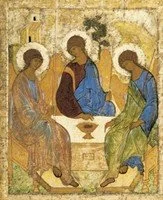
Across the summer, in our Dinner Church sessions, we are going to delve more into this issue of hospitality, wondering together about how we may best welcome the stranger who might also be God. I hope you will be present for those conversations. And perhaps this image from today may linger in your memory for a while.
The image on the cover of your bulletin and the screen is the most well-known Russian icon painted in the 15th century by Andre Rublev. It is old and doesn’t translate well to projection, but you might notice the house on the upper left, a 15th century representation of Abraham’s house which in reality, would have been a very basic tent. I like the detail of the tree in the background, a nod to the oaks of Mamre where Abraham and Sarah lived. This image represents the three strangers receiving hospitality. By Rublev’s time, Christians had come to interpret them as three aspects of God, so this icon is also known as The Holy Trinity.
The Greek word for stranger, xenos, also means guest and paradoxically also host. “This one word signals the essential mutuality that is at the heart of hospitality. No one is strange except in relation to someone else; we make one another guests and hosts by how we treat one another.”[2]
Hospitality begins in preparation, but it may become first evident in how we greet people. We might say “Hello” or “Good morning” or “How are you?” In South Africa, a standard greeting goes like this:
The first person says, “I see you.” The second person responds, “I am here.”
“I see you.”
“I am here.”
Isn’t that lovely? When we show up as a stranger, isn’t that what we want – to be seen, to be recognized for who we are. And to respond, “I am here.” “I am fully present, with all my strengths and weaknesses, bringing my whole self into this place.”
I see you
I am here.
Lutheran pastor, Nadia Bolz Weber, tells about a time when she welcomed a stranger. Before an ordination service, she gathered with other clergy preparing themselves for it. She introduced herself to another pastor, who shook her hand and said, “We’ve met, but I do not expect you to remember. I’ve waited seven years to be able to tell you this: You shared your chicken with me that night and you have no idea what it meant.” She went on to say that she had been at a real low point, in the middle of a very painful divorce. The two women were backstage before one of Nadia’s speaking engagements. This woman was supposed to introduce Nadia. She was exhausted and hadn’t eaten all day. Apparently, I that moment, Nadia looked up from a huge chicken dinner that had been provided for her and said, “I’m never gonna eat all of this, please help me out here.” [3]
Recalling it, the woman said it had nearly made her cry. She, who was technically the host, was blessed with the hospitality of Nadia, who was a stranger and technically the guest. And seven years later, she surprised Nadia with recognition and the shared memory.
This is how it works sometimes. Strangers are received with welcome. There is surprise and blessing and God is present in the midst of it all.
I see you.
I am here.
Thanks be to God.
[1] https://www.workingpreacher.org/commentaries/revised-common-lectionary/ordinary-16-3/commentary-on-genesis-181-10a-6
[2] Ana Maria Pineda in Practicing Our Faith, 2nd edition Dorothy Bass, editor, (San Francisco: Jossey-Bass, 2010) , p. 33
[3] https://thecorners.substack.com/p/the-sacred-act-of-having-no-idea?utm_source=publication-search