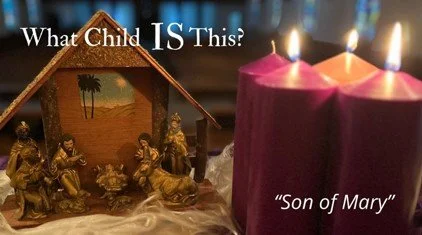
What Child is This? Son of Mary
Luke 1:26-56
Emmanuel Baptist Church; Rev. Kathy Donley
December 14, 2025
Note: A recording of the worship service in which this sermon was preached may be found here: https://www.youtube.com/watch?v=jDHPwyc1dM0
Before she was the mother of Jesus, she was a girl, a young woman growing up in Nazareth. We might imagine her in this story as about 13, keeping in mind that would have been about the age to be leaving her family’s home to marry. She was probably uneducated and from a poor family.
Her hometown, Nazareth, was a village of 100-400 people. It is virtually unknown. There are 63 villages mentioned in the Talmud, which is a collection of rabbis’ commentary on the Old Testament. Sixty-three villages, but Nazareth is not among them. Josephus, a first century historian, lists 45 villages in Galilee in his work, but Nazareth is not among them either.
Nazareth was in the region called Galilee.
Galilee was well north of the Judea and its capital Jerusalem. Galileans were considered lesser Jews by those in the south because they had inter-married with other peoples during generations of conflict. Many were too poor to regularly participate in the worship life in the Temple. Galilee was known for resisting all invading forces, whether they were foreign powers or authorities demanding taxes be paid to Jerusalem. Something was always happening in Galilee – altercations, protests, uprisings.[1]
The girl who grew up in Nazareth would have been shaped that resistance and by the presence of Roman soldiers responding to it. “She [probably] saw soldiers riding into town, terrorizing her neighbors in the name of peacekeeping. She [may have] witnessed uncles humiliated and cousins hurt. She [probably] watched women taken by force to be punished in unspeakable ways. . . . She experienced the push and pull of war and resistance that shaped the villages of Galilee.”[2]
Some might say that in Mary God chose a nobody from nowhere. God might have chosen someone from a bigger city in Galilee or even from Jerusalem to be the mother of Jesus. Some might think that a person like Mary, shaped by violence, resistance and generational trauma might not be the best choice to entrust with the raising of God’s Son. Or maybe only a young rebel would be willing to accept the mission.
One Advent, a grandmother gave her grand-daughter Anna a book about the birth of Jesus and they immediately read it together. The book started the story at the point when the angel Gabriel comes to tell Mary what is going to happen in and to her. The book stated, “And when the angel told Mary she was going to have the baby Jesus, Mary was very happy.” And then, three-year-old Anna interrupted. . “Well actually, Grandma,” she said, “that’s wrong. Mary was afraid.” The grandmother looked back at Hannah and her serious little face and said, “I think you are right, Anna. I imagine Mary was afraid.”[3]
We have to take her fear seriously if we are to enter into this story. Mary is not fearless. She is troubled, agitated, bewildered by Gabriel, but she says yes in spite of that. She is courageous, but not stupid. The more she thinks about it, the more she realizes how much there is to be afraid of.
She needs someone to process this with, someone she can trust, someone who might have an inkling of understanding. The angel had mentioned Elizabeth, who is also unexpectedly pregnant. Maybe she can be that someone.
Elizabeth proves to be worthy of Mary’s trust. Her first words to Mary are “Blessed are you among women.” Today we recognize those words as part of the Hail Mary prayer. But Mary would have recognized them too. This is a known saying, somewhat like Rosie the Riveter saying to women in WWII, “We can do it.” Or more casually like today’s “You go girl!”
“Blessed are you among women” is what the prophet Deborah sang about a woman named Jael during the Biblical time of the judges. Jael drove a tent-peg into the skull of an enemy general and killed him.
“Blessed are you among women” is what the city leader said about a woman named Judith some two or three hundred years earlier. The story goes that Judith decapitated an enemy leader and smuggled his head out of the enemy camp and back to her own, where she displayed it to the cowering male soldiers.
So when Elizabeth says “Blessed are you among women” she puts Mary in the company of ancient heroes. It is as if she summons for Mary all the courage and cunning and strength of her grandmothers. “You’ve got this, Mary” is another contemporary way to put it.
Apparently, that is just the right thing to say, because the next thing we know, Mary is singing, belting out a song that echoes the one Deborah sang about Jael, but also songs by Hannah and Miriam and the psalmist.
We call her song the Magnificat, because of the first line which says “my soul magnifies the Lord.” The song is exuberant and subversive and joyful.
Today is the third Sunday of Advent, the day when we light the pink candle. Also known as Joy Sunday. The lectionary offers the Magnificat as a possible reading every year on Joy Sunday.
This is the crux of the matter for me, how does Mary move from terror to joy? She said yes to Gabriel. She was courageous and dutiful, – but where does she find the capacity for joy?
I think of the character of Ma Joad in John Steinbeck’s book The Grapes of Wrath about the dust bowl. Steinbeck said it was Ma’s habit “to build up laughter out of inadequate materials.” To build up laughter out of inadequate materials.
By all indicators, Mary should have inadequate materials to build up joy. I think about mothers and fathers in Gaza today – from where would they summon joy? Or immigrant families in our city and others who live in fear of being abducted by ICE. Even those whose families are still intact, how can they possibly have joy in the midst of so much fear and trepidation?
But Mary, who is going to raise her son Jesus, in the same place where she grew up, under even more heavy occupation following a rebellion that took place shortly after Jesus was born, young Mary who is shaped by violence and resistance and a keen passion for justice, Mary the courageous one, finds her way to joy that explodes from her in a song.
I think she finds that joy because of Elizabeth, because Elizabeth reminds her of the community of women in which she stands. She enables Mary to tap into the strength she already has, to summon all of who she is to meet this task. Mary’s joy bubbles up because of Elizabeth’s solidarity.
Last month, some representatives from Churches for Middle East Peace came to Albany. They mobilize Christians in the United State to advocate for equality, human rights and safety for Israelis, Palestinians and all people of the Middle East. Jim and I went to Delmar to hear them. One of the speakers was a Palestinian woman named Susan.
Susan’s family lives near Bethlehem in the area called the Shepherd’s Field. People from all over the world make pilgrimages to Bethlehem. Many decades ago, five women on that kind of pilgrimage decided to walk from Bethlehem to Shepherd’s Field. Susan’s mother encountered these women out on their walk and invited them to her house. She was simply offering the hospitality of her culture, providing refreshment on a hot afternoon. Susan’s grandmother was also at the home and the women spent some time together, getting to know each other. The Palestinian women gave home-made sweaters to the Americans.
All of the American women were professors at a college in Michigan. Two weeks after their visit, Susan’s mother received a phone call from those women inviting Susan and her sister to attend their college on full scholarships. With great fear, but also gratitude, the two women accepted. Susan’s sister earned a degree computer science and Susan majored in math.
Susan talked about what life is like there now. She said that 60% of the population earns a living from tourism – all of those pilgrims I mentioned earlier. Whenever there is a crisis in Palestine (and we know happens often), there is no government to sustain trade and people lose their primary source of income for months or even years. So, Susan created the Bethlehem Fair Trade Artisans which markets and exports the kinds of local crafts that would normally be sold to tourists. This is hard work, made more difficult because of US trade policies, but Susan keeps at it. She said, “I want my granddaughter to have a better future, to live without fear.”
Susan lives in an occupied land where it might be easy to give in to despair. But, at a young age, she was strengthened by solidarity and a gift from women much older than her. From that solidarity, she has created a network of purpose and hope, and even I think, joy.
Friends, on this Joy Sunday, I confess to you that I don’t feel very joyful. I live these days mostly in places of duty and dismay. I do what is required of me, but joy seems elusive. And I also have to tell you that I don’t sense a lot of joy among us. As individuals, we are carrying many things – health concerns, care-giving responsibilities, worries about the state of the world and our nation. As the congregation of Emmanuel Baptist Church, we are anxious about the future, pondering decisions with huge implications and not nearly enough information for any confidence. I wonder if we might try to follow Mary’s lead – to let ourselves feel all of these things and then still say yes to God’s call and claim on our lives anyway. If we wait to say yes to whatever God would have us be and do until the moment when we no longer feel any fear at all, we might never say yes to anything.[4] And as we say yes together, can we encourage each into joy?
Mary’s song is joyful, but also subversive. In many times and places it has been illegal to read it in public because it was seen as revolutionary and dangerous. One of my favorite stories about that is that when an Anglican missionary went to Calcutta in 1805, he was appalled to find that the British authorities had banned people from reciting it at Evensong. The British were, of course, the colonizers of India and those spreading Christianity there. On the final day of British rule in India in 1947, Mahatma Gandhi, who was not a Christian, requested that Mary’s song be read in all the places where the British flag was being lowered.[5]
So, as an expression of being joyful even though we have considered all the facts, I invite us to read the Magnificat together. This is a modern version by Rev. Jade Kaiser. It uses the gender-full pronoun “They” to refer to the triune God. Would you read with me please.
My soul is alive with thoughts of God.[6]
What a wonder, Their liberating works.
Though the world has been harsh to me,
God has shown me kindness,
seen my worth, and called me to courage.
Surely, those who come after me will call me blessed.
Even when my heart weighs heavy with grief,
still, so does hope abide with me.
Holy is the One who makes it so.
From generation to generation,
Love’s Mercy is freely handed out;
none are beyond the borders of
God’s transforming compassion.
The power of God is revealed among those who labor for justice. They humble the arrogant. They turn unjust thrones into dust.
Their Wisdom is revealed in the lives and truths of those on the margins.
God is a feast for the hungry.
God is the great redistributor of wealth and resources. God is the ceasing of excessive and destructive production that all the earth might rest.
Through exiles and enslavement,
famines and wars,
hurricanes and gun violence,
God is a companion in loss,
a deliverer from evil,
a lover whose touch restores.
This is the promise They made
to my ancestors, to me,
to all the creatures and creations,
now and yet coming,
and in this promise,
I find my strength.
Come, Great Healer,
and be with us.
Amen.
[1] Kelley Nikondeha, The First Advent in Palestine: Reversals, Resistance, and the Ongoing Complexity of Hope (Minneapolis: Broadleaf Books, 2022), pp 40-41.
[2] Kelley Nikondeha, p 51
[3] Rev. Shannon Kershner, December 20, 2015. Singing Mary’s Song, https://www.fourthchurch.org/sermons/2015/122015.html
[4] Christine Hong, A Sanctified Art commentary on Advent 2, 2022
[5] https://prayerandpolitiks.org/signs-of-the-times/news-views-notes-and-quotes-66/
[6] https://enfleshed.com/blogs/liturgies/marys-magnificat-luke-147-55-remix/