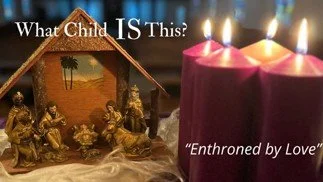
God-With-Us
Matthew 1.18-25
Emmanuel Baptist Church; Rev. Kathy Donley
December 21, 2025
Note: A recording of the worship service in which this sermon was preached may be found here: https://www.youtube.com/watch?v=_fVu2_fcPcI
The Rev. Janet Wolf is a community organizer, college professor and has served as pastor of rural and urban congregations. She remembers the year the annual Christmas program included a very reluctant Joseph.
She writes: “We were trying to pull together a Christmas Play, and our own little Joseph had made it a challenging task. Nevertheless, someone decided our Joseph would be included. He and I would sit up front to remind folks when to come and go. Little Joseph was not enthused: ‘Ain’t coming to no stupid Christmas play. I got better things to do. Hah! My mama’s taking me to the Christmas parade.’”
It seemed unlikely that Joseph’s mama, a single mother with four boys and two part-time jobs, could take Joseph to the parade. So Janet tried again: ‘If you’re not here, the angels might stay too long. The shepherds might forget to show up. We can’t do it without you!’ Joseph’s parting words were these: ‘Ain’t coming to no stupid Christmas play.’”
But he did come, early even, and was wonderfully helpful getting the youngest children into their costumes. Then one of the older kids hollered: ‘Thought you weren’t coming to no stupid Christmas play?’ Janet’s heart sank, sure this would do Joseph in. But Joseph just turned and declared: ‘Course I’m gonna show up. They can’t even do it without me!’”[1]
The story of the incarnation, the story of Jesus being born, could not really be told without Joseph. Even though he never speaks a mumbling word in all of scripture, not even to Mary, his role is essential. It might have all gone so differently.
Mary is pregnant. Joseph knows he is not the father. Mary must not be the person he thought she was. She has broken a contract, violated the law, betrayed his trust. That kind of behavior demands consequences. Matthew describes Joseph as righteous. That means that doing the right thing matters to him, a lot. It also means that he has a good name, a reputation to be protected. On top of that he is likely disappointed, humiliated, crushed and angry. What is the right thing to do?
This is probably the most difficult decision of his life. As far as we know, he struggles with it alone, not asking for advice from friends or family or his local rabbi. One legal option is to formally break the betrothal, to go to the community elders, and explain the situation. If he does that, he could re-coup the bride price which he paid to her family. That might be a little bit of satisfaction. But if he goes public, Mary will be subject to community shame and possibly to death by stoning, if someone decides to make an example of her.
So, he leans towards divorcing her quietly. That means that he will forfeit whatever money is involved. It also means that his side of the story will not be told. People may assume that he is the father and that he is a jerk for abandoning his wife and child. He will take that reputation on himself. Maybe that is the right thing to do. Of course, people may draw their own conclusions and decide that Mary is to blame and should be stoned, or at minimum shunned, anyway.
Whatever the rumor mill churns out, whatever people think, whether Joseph divorces her quietly or publicly, Mary is still going to be an unwed mother without any financial support. That will make her life and the baby’s extremely hard. What is the right thing to do?
I wonder if Joseph reflects on other women he has seen in this kind of situation. Women “found to be pregnant” as the story says about Mary. It doesn’t say who discovered that or how Joseph learned it. But it “fits with patriarchal culture – there is always someone looking to find women doing something they do not approve of.” [2]
As Joseph turns this decision over and over, I wonder if he remembers the women in his own family tree? Because there are at least four women among his ancestors whose sexual morality had come under scrutiny and disapproval. Those women referenced by Matthew in Joseph’s genealogy are Rahab, Tamar, Ruth and Bathsheba. In each case, these many times great-grandmothers of Joseph had to fight against the cultural norms to demonstrate their own righteousness and to demand justice from the men involved. I wonder if they even cross Joseph’s mind as he ponders the right thing to do.
Those women among Joseph’s ancestors mostly had to push back against the system on their own. They demanded justice in risky and subversive ways. We only know their stories because they were successful. How many others did not succeed and were lost to history? This time, God sends an angel to do that pushing on Mary’s behalf.[3]
Joseph decides to do what the angel says. He marries Mary and names the baby Jesus. Naming him serves as a formal adoption, acknowledging Jesus as his own first born son. This baby will be first in line to inherit Joseph’s property and only Joseph knows that he is not the biological father. He can’t even tell anyone about it without casting aspersions on Mary or calling into question his own gullibility. He does the right thing without any credit. That is a reflection of his character and the strength of the love he displays.
Presbyterian minister Tom Long says “Joseph learns that being truly righteous does not mean looking up a rule in a book and then doing the right thing; it means wrestling with the complexities of a problem, listening for the voice of God and then doing God’s thing. To be a faithful disciple means prayerfully seeking to discover what God is doing in the difficult situations we face.”[4]
Last Sunday, we remembered Mary as a hero among heroic women of the past. A feisty, courageous young woman. Today we see Joseph as a different kind of hero, a father who loves with quiet strength and complex wisdom. I’m beginning to see them as a power couple. These are Jesus’ parents. If Mary and Joseph had not said yes to God, the story might have turned out so differently.
The angel says to name the baby Jesus which Joseph does, but there is another name in the story. Emmanuel is a name for Jesus that only Matthew references. It means God-with-us. It is found here at the beginning of Matthew’s book about Jesus and again at the end. The very last words that Jesus says in the very last sentence of the gospel of Matthew are “I am with you always, even until the end of time.
Jesus is never called by the name Emmanuel as far as I know. Maybe it was his middle name. Did they even have middle names? (But I’ve always heard that Jesus’ middle initial was H.)
Even so, it was significant. When this church moved from Pearl Street, our ancestors selected it as the name of the church and of course many other churches have also chosen it. But what does it mean to say Emmanuel, God is with us? How do we know that?
Some people know it when they encounter art – music or a painted masterpiece or a great film. Some identify God’s presence with joy or beauty which makes their senses tingle. Some mystics among us know God in serendipitous happenings or miraculous events. But some of us live without any experience of the thrill of the mysterious, we simply don’t tune in on that wavelength. God-with-us happens for us in moments of deep connection with other people, when their words or actions embody God’s love and grace and kindness in very tangible ways. Some inspire us by their faithful, sacrificial service and care for people they know and love. Others by their passion for justice on behalf of strangers. And some in wise and patient responses to their own circumstances or suffering or tragedy. The goodness of God resonates from them and we know Emmanuel, God is with us.
Joseph stands out as one person who said “I will do the right thing.” As long as there is one person in a community who is willing to wrestle with the complexities and listen for God’s voice and seek to do God’s thing, . . .
as long as there is at least one person will stand for the love and grace and kindness of God, we may know Emmanuel, God with us.
The question is whether we will be that person. [5]
[1] Janet Wolf, Upper Room Disciplines 2009, p 14.
[2] Richard Swanson, https://provokingthegospel.wordpress.com/2016/12/15/a-provocation-fourth-sunday-of-advent/
[3] Richard Swanson, https://provokingthegospel.wordpress.com/2016/12/15/a-provocation-fourth-sunday-of-advent/
[4] Thomas G. Long, Matthew: The Westminster Bible Companion (Louisville: Westminster/John Knox Press, 1997), p. 14.
[5] This ending is taken from the sermon God is With Us by the Rev. Dr. Fred Craddock https://day1.org/audio/5d9b820ef71918cdf2002b36/dr_fred_craddock_on_advent_part_4_god_is_with_us